
EXECUTIVE SUMMARY
- March was a challenging month for equity and bond markets as oil prices surges amid theMiddle East conflict.
- Australia reliance on imported fuel has drawn attention after recent global supply disruptions.
- While uncertainty remains, equity markets typically recover quickly once investors gain clearer visibility.
- The economic impact of recent commodity disruptions is likely to longer to ease.
- Upcoming US earning and Australian trading updates will offer insights into earnings impacts.
- Recent market weakness have brought valuations back to. more attractive levels.
MARCH MARKETS UPDATE
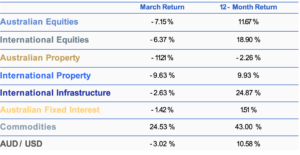
Markets fell sharply in March as surging oil prices and ongoing conflict in the Middle East dampened investment sentiment. Concerns over slowing growth pushed equities lower, with Australian equities down 7.2% and global equities off 6.4% Bonds also weakened on higher inflation and interest rate expectations.
Australia’s fuel crunch
Much of the local media coverage during the war has highlighted Australia’s vulnerability to fuel supply disruptions.Once largely self‑sufficient, Australia now operates only two refineries, compared with eight that supplied most of its fuel needs two decades ago.Over time, those refineries were shut down as they became uneconomic and uncompetitive against newer, larger and more efficient plants built across Asia.
Today, only Viva Energy’s Geelong facility and Ampol’s Lytton refinery in Brisbane remain in operation, supplying less than 20% of Australia’s refined fuel needs. The remaining 80% arrives by ship from countries such as South Korea, Singapore, Japan, Taiwan and Malaysia — all of which rely heavily on crude oil from the Strait of Hormuz. With limited fuel stockpiles, Australia is more at risk if overseas supply chains remain disrupted. The Federal Government has taken steps to shore up fuel supply, relaxing sulphur standards in petrol and using public funds to underwrite additional purchases of fuel, fertilisers and other essentials. As of 6th April, Energy Minister Chris Bowen reported that fuel shipments to Australia are now secured “well into” May. While supplies are being carefully managed, a prolonged disruption to Gulf crude oil shipments could mean tighter measures ahead.
Markets search for direction
As the Middle East conflict moves into its second month, it’s still unclear how events will unfold and when it might be resolved. Unsurprisingly, markets have struggled with the ongoing uncertainty.
What we do know is that markets are forward‑looking and tend to recover quickly once a clear path through uncertainty emerges. History offers many reminders: when then‑ECB President Mario Draghi vowed to do “whatever it takes” to save the euro in 2012, ending the sovereign debt crisis; when COVID‑19 vaccines emerged to stem the pandemic; or when President Trump backed away from tariff threats that risked tipping the global economy into recession.
For now, investors are watching for signs of progress toward ending hostilities and restoring normal oil product flows through the Strait of Hormuz.
Many are also watching Trump’s social‑media posts for clues about what might come next. While his recent messages have aimed to calm markets, patience could fade if tangible steps towards peace aren’t reached soon.
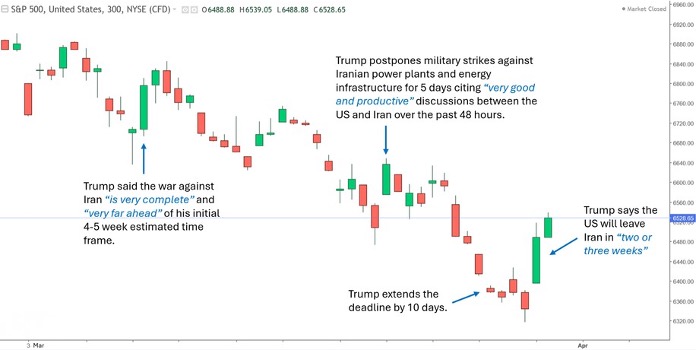
On 8th April, the US and Iran agreed to a two-week ceasefire and re-opening of the Strait of Hormuz, allowing time for a possible diplomatic solution. Equity markets rallied on the news and oil prices dived.
Oil Prices Expected to moderate.
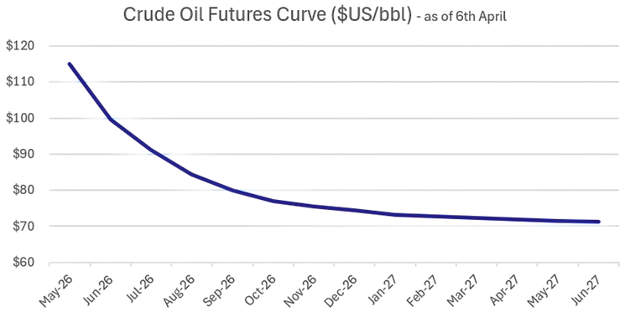
As investors debate how long energy shock might last, oil futures markets are indicating calmer conditions ahead. Prices are expected to moderate towards the mis $70 per barrel over the coming year.
Counting the cost of disruption
While market sentiment can change quickly, the economic impact of the current energy shock is likely to persist for some time. The base case points to higher near-term costs for businesses and consumers. In a worst‑case scenario, extended disruptions could more severely affect operations and output.
In Australia, several sectors are already feeling the strain:
- Mining: Rising diesel costs and growing fuel supply concerns.
- Agriculture: Higher diesel and fertiliser prices, with urea shortages impacting crop farmers ahead of seeding.
- Supermarkets: Higher freight and food costs expected to flow through to retail prices.
- Airlines: Elevated jet fuel costs likely to translate into higher fares.
- Construction: Rising prices for steel, aluminium, concrete and plastics—together with higher transport costs—are lifting project expenses and complicating works in progress.
So far, few companies have quantified the financial impact. Signs of slower activity, shifting consumer demand and earnings pressure are expected to emerge in the coming months. Recent market weakness reflects some of these risks, the key question is how persistent they’ll prove to be. From a macro perspective, sticky inflation could see the RBA tighten further, with markets currently pricing in two more 0.25% hikes by October. The wildcard remains the labour market—any clear signs of softening could prompt a more cautious stance. Rising living costs are squeezing households and could spill over into the banking sector, which remains a major and relatively expensive part of the local market.
MARKETUPDATE

VALUE RETURNS AS PRICES RETREAT.
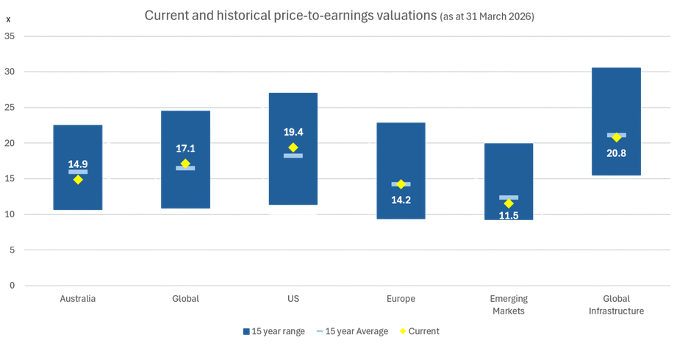
The recent market pullback has eased some of the pressure from previously elevated valuations (earnings multiples). Most notably, US and Global equities are now trading close to their long-term averages. US equities haven’t been this “cheap” since October 2023 and global equities not since April 2024. Australian and Emerging Market equities are trading at discounts to their long-term averages. These markets are more exposed to Gulf energy supply and more sensitive to economic conditions.
ASSET CLASS PERFORMANCE
Sources
Australian Equities: S&P/ASX 200 Accumulation Index. International Equities: MSCI World Index (USD). Australian Property: S&P/ASX 200 A-REIT Index. International Property: S&P Global REIT (USD). International Infrastructure: S&P Global Infrastructure Index (USD Hedged). Australian Fixed Interest: Bloomberg AusBond Composite 0+Yr Index. Commodities: S&P GSCI Index (USD).
Australian Equities
The Australian equity market posted its weakest monthly performance since June 2022, with the S&P/ASX 200 Index down 7.1%. The Materials sector (-13.0%) led declines as investors became more cautious on the global growth outlook amid the ongoing energy crunch. Info Tech (-12.5%) and A-REITs (-11.2%) also recorded double-digit losses. In contrast, Energy (+20.4%) rallied strongly as oil prices surged, with Woodside Energy (+23.8%) and Santos gained (+17.8%) among the standout performers. Defensive sectors such as Utilities (+4.9%) and Consumer Staples (+1.7%) also closed higher. Corporate trading updates in the months ahead will be closely watched for signs of how back-to-back rate hikes and rising energy costs are affecting earnings.
International Equities
Global equities fell sharply in March, with the MSCI All-World Index down 6.4%. Economically sensitive regions including Japan (-12.6%), Emerging Markets (-10.1%) and Europe (-9.9%) led the declines. US markets proved more resilient, with the S&P 500 Index losing 5.0%. Investors generally see US companies as less exposed to current conditions (energy self-sufficiency and tech index concentration) and analysts have continued to upgrade earnings forecasts. The upcoming April reporting season should offer more clarity on how durable that outlook remains.
Property & Infrastructure
Rising inflation and renewed expectations for higher interest rates weighed heavily on listed property assets in March.
Global property fell 11.2%, while Australian property declined 9.6%.
Higher rates pressure operating earnings through increased debt costs and also weigh on valuations.
Global Infrastructure held up well, recording only a modest 2.6% decline for the month.
Fixed Income
The Bloomberg Australian Bond Index fell -1.42% in March.
The RBA raised the cash rate by 0.25% for the second consecutive month, citing persistent inflation risks. Financial markets have now fully priced in another 0.50% in rate increases by October 2026.