
EXECUTIVE SUMMARY
Equity markets extended gains into May, supported by strong corporate earnings across the US and Asia.
Australian equities underperformed, as higher interest rates and potential tax changes weighed on sentiment.
Our portfolio positioning remains focused on balancing return objectives with a defensive bias.
Growth opportunities include global quality and broad US exposure as AI beneficiaries expand.
Resources and global infrastructure can help protect portfolios against inflation.
High-quality fixed-rate Australian bond funds remain attractive and further build diversification in multi-asset portfolios.
SUPER CONTRIBUTIONS
With 30 June approaching, now is a good time to consider any superannuation contributions you may wish to make before financial year end.
MARKET UPDATE
Equity markets extended gains into May, supported by easing geopolitical tensions and strong corporate earnings across the US and Asia.
Progress in US–Iran negotiations improved toward month-end, lifting expectations of a potential resolution and contributing to a sharp fall in oil prices, from around US$105 to US$90 per barrel.
The US and Japan led regional market gains, while China and Australia lagged. Domestic sentiment was weighed down by a third consecutive RBA rate hike and concerns around the Federal Budget’s proposed tax changes.
Global economy remains resilient
Recent data suggests the global economy remains relatively resilient, with the energy shock having a more limited impact than initially feared. However, conditions remain uneven across sectors and regions.
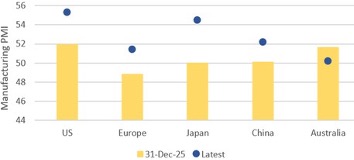
Manufacturing activity has been strong, partly driven by businesses building inventories ahead of potential supply chain disruptions linked to the Middle East. This front-loading may see activity moderate in the months ahead.
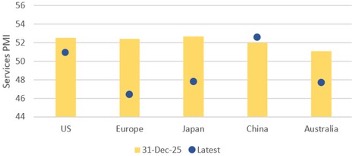
In contrast, the services sector has softened, reflecting pressure on consumers from higher prices.
MANUFACTURING SECTOR HAS STRENGTHENED
SEVICES SECOTOR HAS SOFTENED
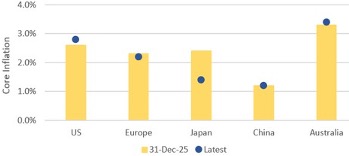
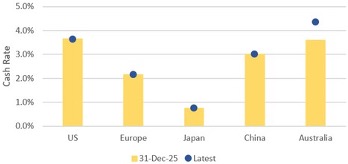
In Australia, inflation was already elevated prior to the Iran conflict, with higher energy prices adding further pressure. The RBA has responded with three rate increases totalling 0.75% since February. Elsewhere, most major central banks have held rates steady, balancing inflation and growth risks.
INFLATION REMAINS STICKY
AUSTRALIAN RATES ARE GLOBALLY HIGH
Resources sector lead ASX gains
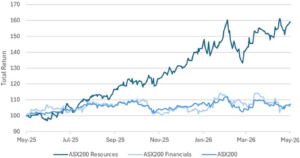
As much of the ASX contends with weaker demand and cost pressures, the resources sector has been a bright spot. Strong commodities demand from AI/data centres, electrification, defence and infrastructure has supported prices and improved the earnings outlook for Australia’s resource and energy sectors.
As a result, the resources sector has significantly outperformed both the ASX 200 Financials sector and the broader ASX 200 over the past 12 months.
RESOURCES HAVE OUTPERFORMED
Targeted resources and energy sector exposures
Drivers of the ASX resources sector continue to broaden beyond the traditional reliance on Chinese iron ore demand. For example, copper has recently overtaken iron ore as BHP’s largest earnings contributor. Copper prices have risen +32% over the past 12 months and +68% over three years, with the outlook remaining positive.
THE COMMODITIES THAT MATTER MOST FOR THE ASX
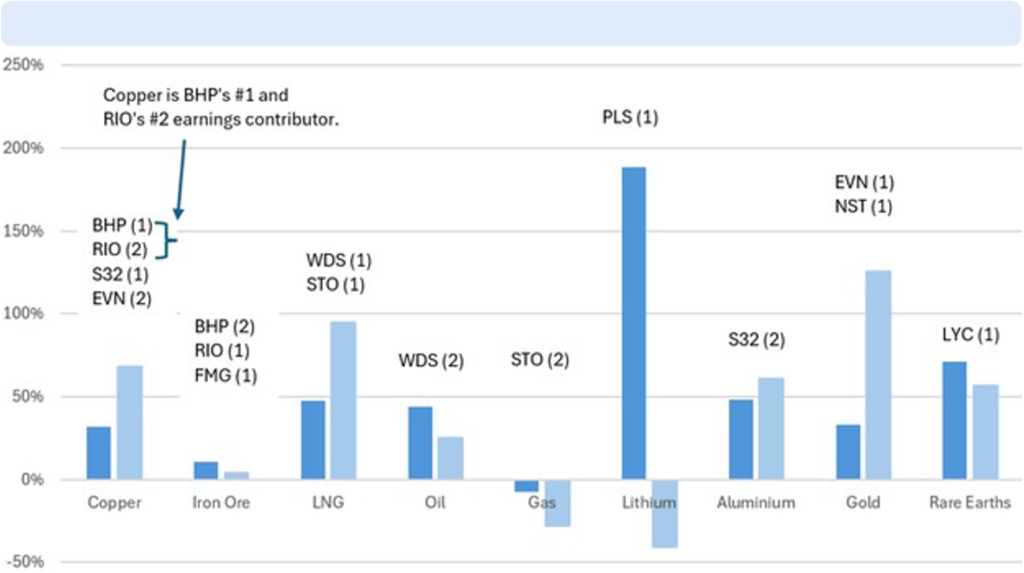
Higher LNG prices have boosted the profitability of Woodside Energy (ASX: WDS) and Santos (ASX: STO).
Lithium prices have rebounded sharply alongside growing demand for energy storage, with Pilbara Minerals (ASX: PLS) quadrupling in value over the past year.
Gold and rare earth prices have also remained elevated, underpinning performance from Northern Star (ASX: NST) and Lynas Rare Earths (ASX: LYC).
For investors seeking targeted exposure to commodity-linked companies through ETFs, our preferred options include:
- ASX: MVR – VanEck Australian Resources ETF (diversified exposure)
- ASX: FUEL – BetaShares Global Energy Companies AUD hedged ETF
- ASX: WIRE – Global X Copper Miners ETF
- ASX: VOLT – ETF Shares Global Lithium Miners ETF
- ASX: GDX – VanEck Gold Miners ETF
Federal budget adds to local challenges
The 12th May Australian Federal Budget compounds an already challenging backdrop for investors, with negative gearing and CGT changes landing alongside sticky inflation and higher interest rates.
What are the proposed changes?
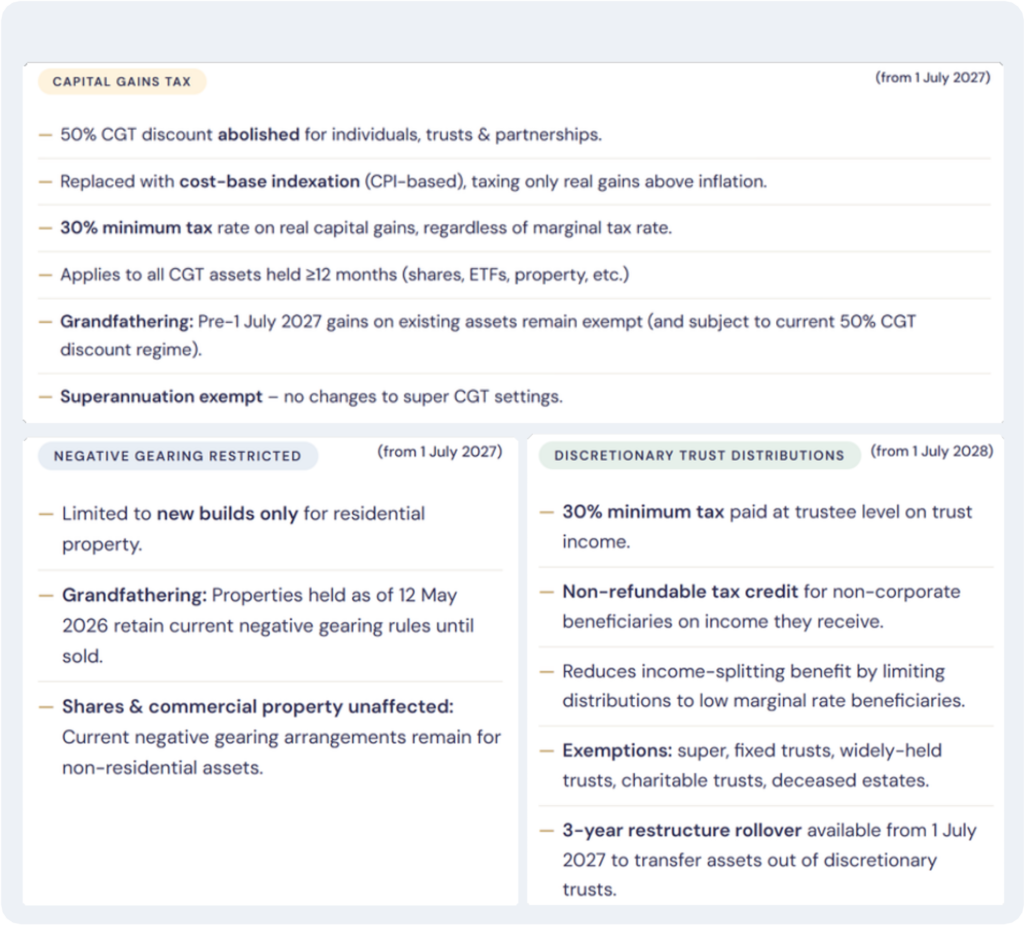
SHORT-TERM IMPLICATIONS
Slower economic growth amid policy uncertainty, with delayed investment decisions and reduced activity.
LONG-TERM IMPLICATIONS (subject to final legislation) could include:
- Australian productivity, innovation and jobs hit.
- Capital flight to lower-tax jurisdictions (e.g., Singapore, New Zealand).
- Entrepreneurs and startups relocating offshore.
- Greater preference for tax-free principal residence over investment properties.
- Shift toward shares (negative gearing preserved) vs. property investment.
- Increased demand for income-generating assets (franked dividends) vs. growth assets.
- More investment held inside superannuation (CGT settings unchanged).
Seek to capture innovation and quality for growth
- Productivity-boosting innovation is the best ingredient for long term equity market returns.
- Growth in productivity results in more output for a dollar of input which ultimately shows up as profit growth.
- The development of the super brain is broadening from idea generators (hyperscalers) to builders (hardware) with the goal of reaching businesses to deliver efficiency.
- We currently take the view that US companies are likely to lead the global adoption of AI tools. (ASX:QUS)
- Quality companies with low debt are best positioned to invest in AI infrastructure and tools. (ASX:QUAL)
- Sector winners from AI tools are likely to include the healthcare and financial sectors. (ASX:IXJ and ASX:BNKS)
- While there will be new winners, more broadly, good businesses will become even stronger.
Seek to capture inflation protection
- Assets, including equities, are generally net beneficiaries in periods of higher inflation.
- Each time is unique, this time it’s a mix of AI build demand but also elevated oil prices due to a supply shortfall.
- Analysts expect inflation to peak in May/June. The messaging from the bond market is however for inflation pressure to persist into year end.
- Resource companies provide inflationary protection should demand remain strong. (ASX:MVR)
- Infrastructure companies provide long term pricing power but also some funding pressure. (ASX:IFRA)
- Precious metals have proven to be resilient in periods of higher inflation but also more volatile. (ASX:GOLD)
Be cautiously invested
- Growth assets should be positioned in such a way to capture a continued rise in equity markets and potential weakness due to inflation.
- The pricing of higher interest rates in the face of higher inflation expectations is currently underway and that may pressure equities, infrastructure and gold in the short term.
- Opportunistically adding quality investments on weakness is likely to drive long term returns significantly.
- Adding unhedged global equities should offer portfolio defence if recession risks rise and/or AUD weakens.
The most important number of them all
- The 10-year bond yield has long been the single most important metric for investors.
- In Australia, the 10-year government bond yield is climbing higher once again.
AUSTRALIAN 10 YEAR BOND YEILD
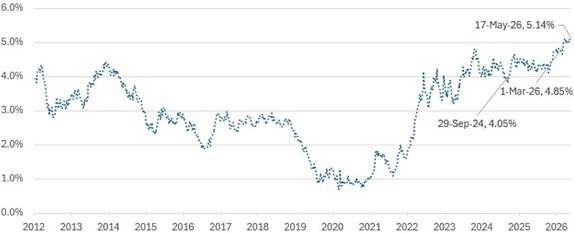
- Current bond pricing is more attractive than when the AI buildout talk gained steam in October last year (bond prices move inversely to yields).
- Current bond pricing is also more attractive than when the Iran war started on 28 February.
- Bond investors are clearly pricing higher inflation, and the above drivers of inflationary pressures remain.
- Current yields on offer from Australian Fixed rate bonds are as good as they have been in more than a decade.
- Yes, inflation may persist for longer, but yields are adjusting to reflect this which is positive for investors.
- Our preference is to add moderate to longer duration fixed rate bond ETFs such as ASX:VACF, ASX:OZBD and ASX:FIXD.
- At some point attention will shift to the deflationary impact of AI and so too are oil supply pressures likely to be transitory.
- ASSET CLASS PERFORMANCE
ASSET CLASS PERFORMANCE
AUSTRALIAN EQUITIES
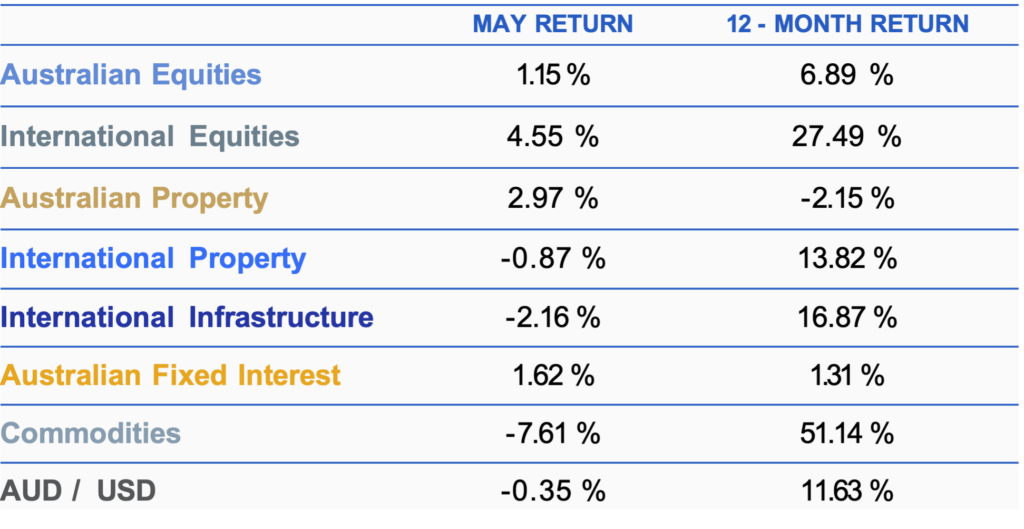
- The S&P/ASX 200 Index rose +1.1% in May, though performance was driven by a narrow group of stocks and marked sector divergence.
- Materials was the clear standout, gaining +10.5% as stronger demand and higher prices for copper and iron ore lifted the sector. BHP surged +16% to a record high, while Rio Tinto and Fortescue also posted double-digit gains.
- Consumer Discretionary rose +4.7%, helped by a +9.4% rebound in Wesfarmers from its 12-month low.
- Healthcare was the weakest sector, declining -8.7% amid rising cost pressures and margin concerns. CSL fell below $100 per share for the first time in a decade.
- Utilities dropped -7.6% on the back of a -10.2% decline in Origin Energy.
- Looking ahead, June typically brings increased tax-loss selling as investors realise losses to offset capital gains ahead of 30 June. Recent underperformers within the ASX 100, including Cochlear and CSL, may see continued pressure.
INTERNATIONAL EQUITIES
- Global equities delivered strong gains in May, with the MSCI All-World Index rising +4.5%.
- US markets led the advance, driven by strength in technology. The Nasdaq climbed +8.4%, the S&P 500 rose
- +5.3% and the Dow Jones added +2.9%.
- First-quarter US earnings exceeded expectations, with overall growth of around 30% year-on-year. Excluding technology, earnings still grew by a solid 20%, underscoring broad-based resilience.
- Positive sentiment toward technology exposures extended into Asia, where semiconductor-heavy markets such as South Korea and Taiwan outperformed. Valuations in parts of the region continue to be viewed as a more attractive entry point into the AI theme.
- Japanese equities gained +7.2%, supported by stronger-than-expected first-quarter GDP, driven by exports and domestic consumption.
- European equities rose +2.7%, with earnings growth of around 5% and recent economic data pointing to softer conditions.
- Emerging Markets added +3.8% boosted by strong gains in Taiwanese semiconductor stocks.
PROPERTY & INFRASTRUCTURE
- Australian listed property rose +3.0% on the back of a +7.1% gain in Goodman Group after it reaffirmed its 9% FY26 earnings growth target.
- Global listed property and global infrastructure were softer, declining -0.9% and -2.2% respectively.
FIXED INCOME
- Fixed income markets were volatile in May, reflecting uncertainty around the growth and inflation implications of the Middle East conflict and the associated energy shock.
- The Australian Government 10-year bond yield rose to a 15-year high of 5.14% before easing to 4.84% by month-end as oil prices retreated.
- The decline in yields supported bond returns, with the Bloomberg Australian Bond Index gaining +1.62% over the month.
- Following 0.75% of rate increases earlier this year, markets are pricing in one additional hike by December. The Reserve Bank next meets on 16 June.